"Reselling" and "rebilling" get used interchangeably, but inside GoHighLevel they're two different levers — and the difference decides which plan you actually need. Reselling is selling GoHighLevel itself, under your brand, as your own product. Rebilling is passing the platform's usage costs — phone and email, and eligible usage-based apps — through to your clients, optionally with a markup you keep. This guide walks through both from my own agency account, and it's part of our complete GoHighLevel white-label & SaaS agency guide.
This page has affiliate links; if you start a trial through one we may earn a commission at no cost to you. I only write about features I actually use.
Reselling vs rebilling — the distinction that matters
Get these two straight before you touch a pricing page, because agencies pick the wrong plan by conflating them.
- Reselling is selling GoHighLevel as your software. You put your brand on it, package it into plans, and charge a monthly price you set — the client is buying your product, not GoHighLevel's. That's the SaaS Mode side of the house, and it leans on white-label setup so the platform reads as yours.
- Rebilling is narrower and easier to get running: the platform's consumption costs — phone and email usage, and eligible usage-based marketplace apps — get billed through to the client instead of eating into your margin. On the plan that allows it, you can add a markup on top of those pass-through costs and keep the spread.
Rebilling is the one most people mean when they ask "how do I make money reselling GoHighLevel" — it turns a cost center into a margin line without you fronting any inventory. Reselling proper is the bigger move where you're selling seats of the platform itself.
Which plan lets you add markup
This is the part worth being precise about, so I'll attribute it: as of July 2026, GoHighLevel's pricing page draws the line by plan tier (confirm the current numbers before you commit — vendor pricing moves).
- Starter (listed at $97/month) — basic reselling only, and a small cap on sub-accounts. Fine for testing, not for scaling a book of clients.
- Unlimited (listed at $297/month) — lets you rebill usage without markup. You can pass phone and email costs through to clients, but you're recovering cost, not making a spread on it.
- Agency Pro (listed at $497/month) — this is the tier that unlocks rebilling with markup, plus SaaS Mode for full reselling. If the goal is margin on usage, this is the line you have to cross. My own account is on this tier, so the screenshot below shows the reselling controls in a live account.
So the rule of thumb: Agency Pro is the tier that unlocks rebill-with-markup and full SaaS reselling (Enterprise includes them too); rebill-at-cost is Unlimited. For the full tier-by-tier breakdown and annual pricing, see our complete GoHighLevel pricing breakdown rather than trusting a number you saw in a forum.
Inside the Reselling screen
Here's what the actual Reselling area looks like in my agency dashboard. It sits in the left-hand agency menu, and it splits into Core Services (the resell offers GoHighLevel packages up for you) and Marketplace Apps.
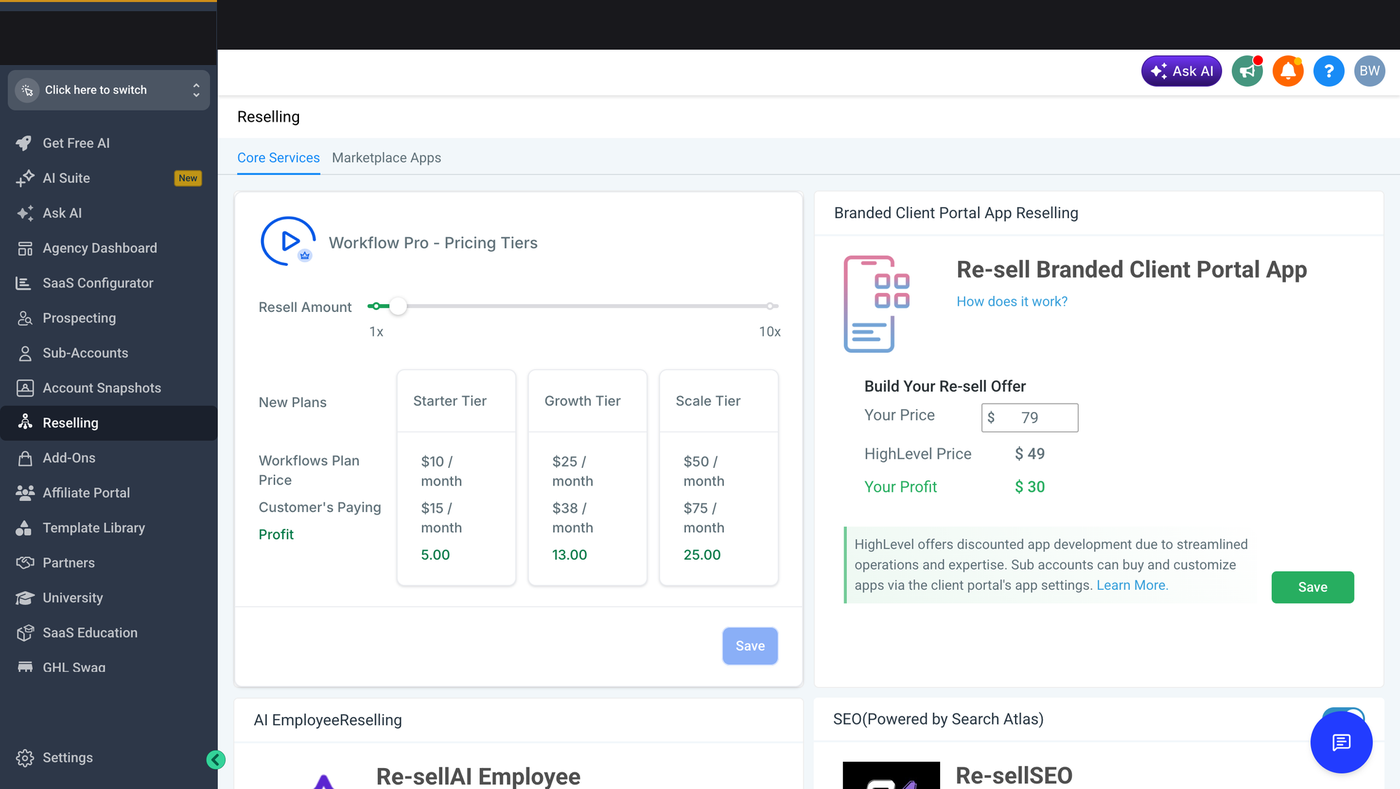
Two things on this screen tell you how the money works:
- The resell-amount slider (1x to 10x). For a resellable service you drag your markup multiplier, and GoHighLevel previews the tiers your client would see — in the built-in example above, a Workflow Pro plan is marked up across Starter, Growth, and Scale tiers, and the screen shows both the price your client pays and your resulting profit for each tier.
- The "Build Your Re-sell Offer" panel (here, re-selling a branded client-portal app). This is the clearest illustration of the resell-markup mechanic: you set Your Price, GoHighLevel shows its own HighLevel Price underneath, and the difference is displayed as Your Profit. In the built-in example it's a $79 price over a $49 cost for $30 of margin. You set the number your client pays and keep the spread.
The takeaway: the markup isn't a spreadsheet you maintain on the side. It's a control inside the product, and once it's set, the marked-up price is what your client sees.
This is built into GoHighLevel. Try it free for 30 days →
Marking up usage-based marketplace apps
The Marketplace Apps tab (still under the Reselling screen in GoHighLevel's menu) is really rebilling in the sense we defined earlier: third-party, usage-based tools — the ones that charge by consumption (SMS credits, email sends, AI tokens) rather than a flat fee — get billed through to your client with a markup you set. Because the cost scales with what your client actually uses, your margin scales with them automatically, with no license to buy up front.
In practice you enable reselling at the agency level, then set your markup per eligible app. GoHighLevel generally offers two ways to mark up:
- Percentage markup — add a percentage on top of the vendor's cost (say, 30% over what the app charges).
- Fixed markup — add a flat amount per unit (for example, a set fee per SMS).
Not every marketplace app allows the same margin, and some vendors set their own limits — so check the reseller terms on an app before you build pricing around it. The advice I'd give my past self: start with one high-volume, low-cost service like SMS, get comfortable with how the billing flows to the client's invoice, then expand. And keep it transparent — clients accept a fair markup far more easily when they can see they're paying for usage plus your support, not a mystery number.
Letting clients cancel add-ons themselves
Once you're reselling add-on subscriptions, the follow-on question is who handles cancellations. GoHighLevel lets sub-account users cancel their own add-on subscriptions from their billing settings, so you're not the bottleneck for every downgrade — while you stay in control of which subscriptions are self-cancellable and whether they can be reinstated. Worth being clear on the boundary: this covers add-ons, not a client's core platform subscription.
When you set it up (in the agency billing/subscriptions area), you typically choose how a cancellation lands:
- Immediate — access ends and billing stops right away.
- End of billing cycle — the subscription runs out the period already paid for, which avoids mid-cycle refund arguments and protects your recurring revenue.
Two things I'd point out. First, canceling an add-on doesn't delete the sub-account or its data — contacts, campaigns, and settings stay intact, which matters if you keep each client walled off in their own workspace (see our guide to sub-accounts and snapshots). Second, because cancellations flow through the platform instead of your inbox, you get real churn data to look at instead of a pile of support emails.
See the reselling controls in a live account
Open the Reselling screen, set a markup, and see the margin preview yourself. This link starts an extended 30-day trial (GoHighLevel's standard trial is 14 days — the longer window is a bootcamp promo).
Start your 30-day trial →Is reselling GoHighLevel legit?
Yes — reselling and rebilling are built-in, sanctioned features, not a loophole. GoHighLevel designed the platform for agencies to rebrand and resell it; the Reselling screen, the markup slider, and SaaS Mode exist precisely so you can sell the platform as your own product. You're not reselling something you're not allowed to. Where agencies get into trouble isn't legitimacy, it's transparency: mark up fairly, tell clients what they're paying for, and deliver support that justifies the margin. Do that and reselling GoHighLevel is a clean, recurring-revenue business model. Skip it and you'll churn clients no matter how the billing is configured.
Once the billing model is set, the next pieces are branding the platform so it reads as yours and structuring each client cleanly — the agency, white-label & SaaS overview ties reselling, white-label, and sub-accounts together.
Frequently asked questions
What does it mean to resell GoHighLevel?
Reselling GoHighLevel means selling the platform to your clients under your own brand and pricing, as if it were your software. You white-label it, package it into plans, and charge a monthly price you set — the client is buying your product, and GoHighLevel is the engine underneath. It's a built-in, sanctioned model, not a workaround.
What's the difference between reselling and rebilling?
Reselling is selling the platform itself as your branded product. Rebilling is passing GoHighLevel's usage costs — phone and email, and eligible usage-based apps — through to your clients, optionally with a markup you keep. Rebilling is the narrower, easier-to-start version; reselling proper is the full SaaS play.
What plan do I need to rebill with markup?
As of July 2026, GoHighLevel lists rebilling with markup and full SaaS reselling starting on the Agency Pro plan (listed at $497/month), while the Unlimited plan (listed at $297/month) allows rebilling usage at cost, without markup. Confirm current pricing on GoHighLevel's site — see our pricing guide for the full tier breakdown.
Is reselling GoHighLevel legit?
Yes. Reselling and rebilling are official features GoHighLevel builds for agencies — the Reselling screen and SaaS Mode exist for exactly this. The thing that makes or breaks it isn't legitimacy but transparency: fair markups, clear billing, and support that earns the margin.
Keep learning: the full agency, white-label & saas guide library.